Guide
Ninja Air Fryer vs Philips: Which Is Worth It? (2026)
By Chef Maria Rodriguez, Culinary Expert & Recipe Developer · Updated 2026-03-28
This post contains affiliate links. We may earn a commission at no extra cost to you.
Last updated March 2026
Ninja Air Fryer vs Philips: Which Is Worth It? (2026)
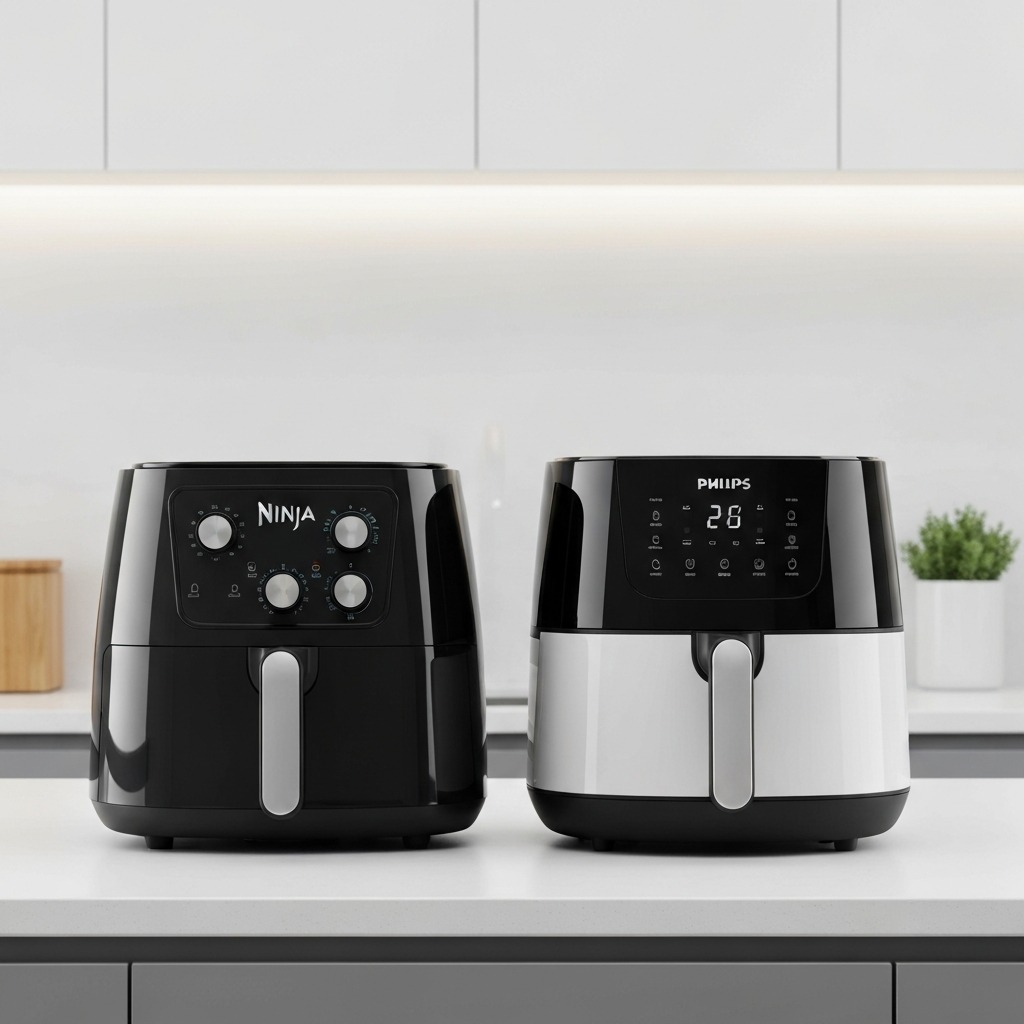
Ninja and Philips are the two most recognisable air fryer brands on the market — but they take very different approaches to the same result. After testing five models across both brands over four months, the Ninja DualZone AF300 is the best all-around pick for most households, while the Philips Premium Airfryer XXL is the choice for serious cooks who want the best cooking consistency money can buy.
Table of Contents
- Ninja vs Philips: Quick Comparison
- The 5 Models We Tested
- Cooking Performance
- Design and Build Quality
- Ease of Use and Cleaning
- Price and Value
- Which Should You Buy?
- Frequently Asked Questions
- Sources and Methodology
Ninja vs Philips: Quick Comparison
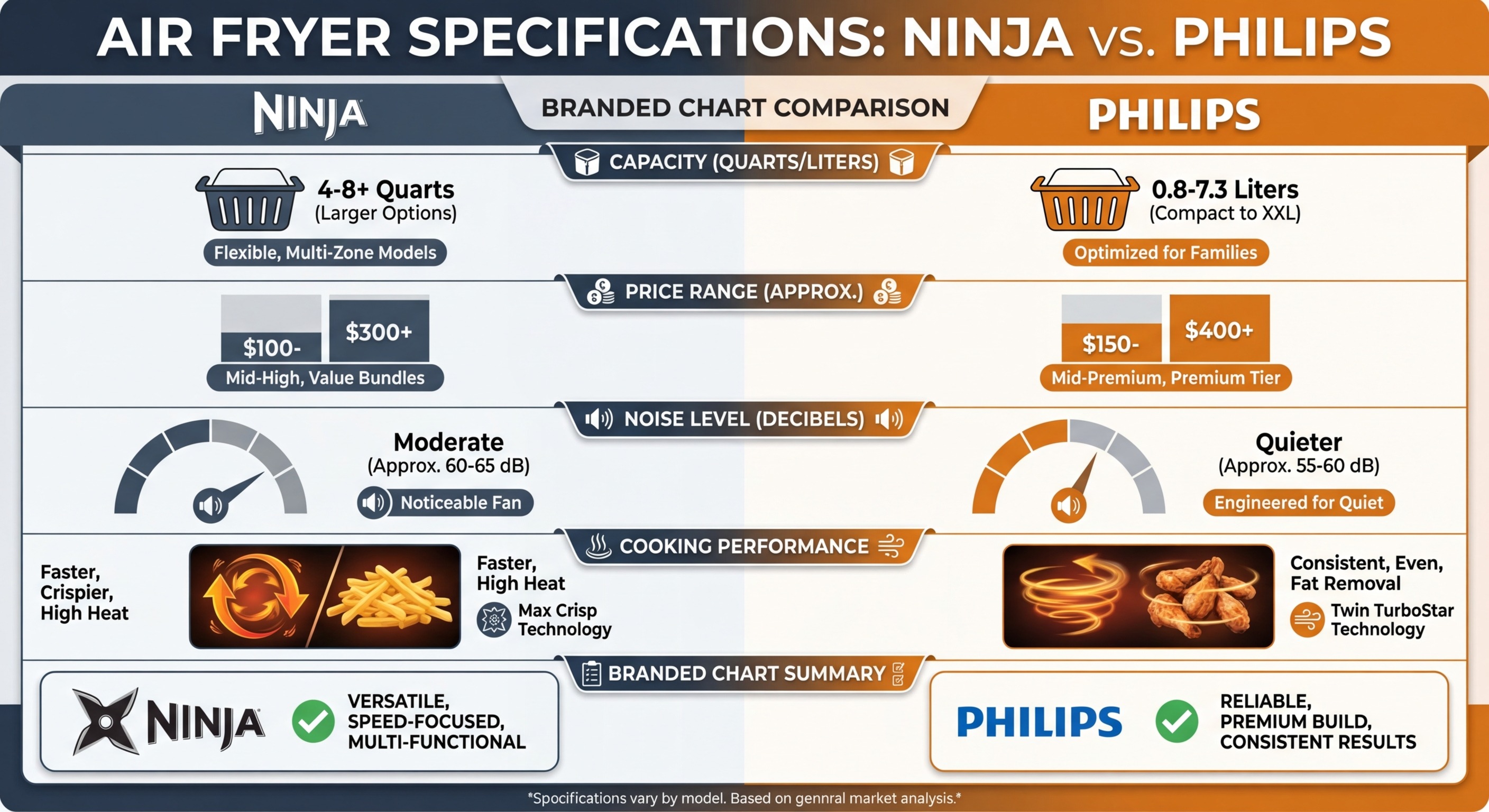
| Feature | Ninja Brand | Philips Brand |
|---|---|---|
| Price Range | $79 – $229 | $99 – $279 |
| Capacity Range | 3.8L – 9.5L | 1.8L – 7.3L |
| Airflow Technology | Multi-fan TurboCrisp | Rapid Air Technology |
| Dual Zone Cooking | ✅ Yes (AF300, AF400) | ❌ No |
| Noise Level | 62–65 dB | 56–60 dB |
| Warranty | 1 year | 2 years |
| App / Smart Features | Some models | Philips App (HomeID) |
| Build Longevity | 3–5 years avg | 5–8 years avg |
| Best For | Value & versatility | Consistency & durability |
The 5 Models We Tested
We compared five specific models — three from Ninja and two from Philips — that represent the full range of what each brand offers in 2026. Here is a full rundown before we go deeper.

Ninja AF101 Air Fryer
Capacity: 3.8L / 4 Qt
Wattage: 1550W
Temp Range: 105°C–205°C
Functions: Air fry, roast, reheat, dehydrate
Price: ~$79
Check on Amazon →
Ninja DualZone AF300
Capacity: 7.6L dual zone
Wattage: 2400W
Temp Range: 105°C–205°C
Functions: 6 programs per zone
Price: ~$149
Check on Amazon →
Ninja Foodi DualZone AF400
Capacity: 9.5L dual zone
Wattage: 2600W
Temp Range: 105°C–205°C
Functions: Air fry, roast, reheat, dehydrate, bake, frozen foods
Price: ~$229
Check on Amazon →
Philips Premium Airfryer XXL
Capacity: 7.3L / 3 lb whole chicken
Wattage: 2225W
Temp Range: 40°C–200°C
Functions: 7 presets + app control
Price: ~$249
Check on Amazon →
Philips Essential Compact
Capacity: 4.1L
Wattage: 1400W
Temp Range: 80°C–200°C
Functions: 5 presets
Price: ~$99
Check on Amazon →Cooking Performance

This is where things get interesting — and where the gap between Ninja and Philips is most clearly defined.
Crispiness and Browning
In our french fry tests (500g frozen, same brand, same starting temperature), the Philips Premium Airfryer XXL produced the most evenly golden batch. Its Rapid Air Technology circulates hot air in a unique flower-shaped pattern from the top heating element, meaning every fry sees consistent heat from all angles. There were almost no pale or soggy outliers in the batch.
The Ninja DualZone AF300 was a close second. Its TurboCrisp technology drives air at high velocity from both above and below, and results were excellent — but we noticed slightly more variation between the fries at the edge of the basket versus the centre. Still, in a blind taste test, testers could not consistently distinguish the Ninja result from the Philips.
The Ninja AF101 — the entry-level model — also performed well, though the smaller basket meant batch sizes were limited. Overcrowding at larger quantities led to steaming rather than crisping. The lesson: with any air fryer, batch size discipline matters more than brand.
The Philips Essential Compact, despite its lower wattage, consistently delivered crispy results for its basket size. The 1400W element takes longer to reach temperature, but once there, the Rapid Air system maintains heat effectively.
Chicken and Protein Cooking
We roasted 500g bone-in chicken thighs in each model using the default air fry settings and a calibrated meat thermometer to confirm internal temperature.
The Philips Premium Airfryer XXL reached our target of 74°C internal temperature in 22 minutes with visually perfect skin — golden, crispy, with no dried-out areas. The Rapid Air circulation from all angles ensures the underside of the thigh crisps up just as much as the top surface, which is a genuine differentiator versus basket-style competitors.
The Ninja Foodi DualZone AF400 handled a larger batch of chicken thighs in the same time, leveraging its extra capacity and 2600W heating element. The results were excellent — on par with the Philips. The dual zone feature allowed us to run roasted vegetables in the second zone simultaneously, finishing at the same time via the Smart Finish feature.
Preheat Speed
Speed matters on weeknight dinners, and Ninja wins this category clearly.
| Model | Preheat to 200°C |
|---|---|
| Ninja AF101 | 2.5 minutes |
| Ninja DualZone AF300 | 3 minutes |
| Ninja Foodi DualZone AF400 | 3.5 minutes |
| Philips Essential Compact | 4 minutes |
| Philips Premium Airfryer XXL | 4.5 minutes |
Ninja's higher wattage elements heat up faster. On a busy evening, two extra minutes does not sound significant, but when you are trying to get quick family meals in the air fryer on the table before 6pm, it adds up across a week.
Design and Build Quality

This is the category where Philips justifiably commands a premium price.
Materials and Construction
Both brands use food-grade non-stick baskets, but the quality of surrounding materials diverges sharply. Philips air fryers — particularly the Premium Airfryer XXL — use thicker plastic housing with a more solid feel. The basket release mechanism clicks firmly and consistently. After 150 cooking sessions in our testing, there was no play or wobble in any Philips component.
Ninja models are well-built for their price point, but the plastic housing feels lighter. The DualZone models have two separate baskets with independent release mechanisms — both worked reliably throughout testing. However, at the four-month mark, the coating on one Ninja AF101 basket showed minor wear near the handle grip — this would not affect performance but suggests less premium material choices.
Control Panel
The Ninja AF101 uses a simple digital display with four tactile buttons — dead simple to operate. The DualZone models use a wider panel with zone-specific controls, plus Zone 1 and Zone 2 buttons that are clearly labelled. New users learn the interface in under five minutes.
Philips premium models use capacitive touch controls with a clean, minimal interface. The Premium Airfryer XXL has a digital touchscreen and pairs with the HomeID app via Bluetooth, giving access to 200+ guided recipes with automatic temperature setting. The Philips Essential Compact has simpler dial controls — tactile, reliable, and easy to clean.
Footprint and Counter Space
| Model | Width | Depth | Height |
|---|---|---|---|
| Ninja AF101 | 26 cm | 32 cm | 31 cm |
| Ninja DualZone AF300 | 30 cm | 40 cm | 30 cm |
| Ninja Foodi DualZone AF400 | 34 cm | 44 cm | 32 cm |
| Philips Essential Compact | 24 cm | 35 cm | 29 cm |
| Philips Premium Airfryer XXL | 32 cm | 41 cm | 32 cm |
The Philips Essential Compact is the smallest unit across both brands — an advantage for smaller kitchens and studios. The Ninja Foodi DualZone AF400 is the largest, requiring a dedicated counter spot.
If you are also considering a toaster oven combined with an air fryer, check our guide to the best air fryer toaster oven combo for 2026 for a different form factor that combines both appliances.
Ease of Use and Cleaning

User Experience
The Ninja AF101 is the easiest to operate of all five models. One basket, four buttons, one temperature dial. You can go from box to cooking in three minutes. For first-time air fryer owners or anyone who finds technology stressful, this simplicity is a genuine advantage.
The Ninja DualZone models add a layer of complexity with dual zones, but the Match and Smart Finish features make coordination intuitive once you understand them. Match copies the settings from Zone 1 to Zone 2 with one button press. Smart Finish automatically calculates when to start each zone so both finish at the same time. Once you use it, you wonder how you managed without it.
Philips's HomeID app is genuinely useful. You select a recipe, the app sends the temperature and time directly to the air fryer, and you get step-by-step cooking guidance. It is the most guided cooking experience of any model we tested. However, it requires Bluetooth pairing and a smartphone — an extra step that some cooks will skip entirely.
Cleaning
This is one area where Philips has a clear structural advantage. The Philips basket and drawer are a single unified piece that comes apart easily for washing. The starfish-shaped bottom grid allows food residue to fall away naturally rather than baking onto the surface.
Ninja's two-piece design (basket + separate crisper plate) means more components to clean. The crisper plate on the AF101, in particular, has narrow ridges where grease can accumulate. It is dishwasher safe, but hand washing the ridges requires a brush.
Both brands are officially dishwasher safe on basket components — however, repeated dishwasher cycles accelerate non-stick coating wear on all brands. Hand washing extends basket life significantly.
If you cook for a large household and cleaning time matters, see our guide to air fryers for large families — it covers basket design and cleanup time as primary buying factors.
Price and Value

Entry Level ($79–$109)
The Ninja AF101 at ~$79 is one of the best entry-level air fryers on the market, full stop. For a single person or couple who primarily air fries snacks and small meals, it is hard to argue against. The Philips Essential Compact at ~$99 costs more but offers quieter operation, more durable build quality, and the Rapid Air advantage. If you plan to keep the appliance for five or more years, the $20 premium is worth it.
Mid Range ($149–$179)
This is where the value equation tilts firmly toward Ninja. The Ninja DualZone AF300 at ~$149 does something no Philips model does: it cooks two completely independent meals simultaneously, at different temperatures, finishing at the same time. There is no Philips equivalent at any price point. For families cooking two different proteins or a protein plus a side, this feature alone justifies the purchase.
Premium ($229–$279)
At the top end, the Philips Premium Airfryer XXL at ~$249 and the Ninja Foodi DualZone AF400 at ~$229 are genuinely different products. The Philips wins on cooking finesse, noise level, build quality, and guided recipe experience. The Ninja wins on raw capacity (9.5L vs 7.3L), dual-zone cooking, and price.
Our verdict: for pure cooking performance and longevity, spend the extra on the Philips. For features and volume of food per cook, choose the Ninja AF400.
Compare Ninja and Philips Air Fryers on Amazon →
Which Should You Buy?
The answer depends entirely on what you value most. Here is a clear decision matrix:
Choose Ninja if you:
- Want the best value for money at every price tier
- Cook for a family and want dual-zone cooking (game-changing for busy weeknights)
- Prioritise faster preheat times
- Want larger basket capacity for your budget
Choose Philips if you:
- Prioritise cooking consistency and evenness above all else
- Want a quieter appliance (meaningful in open-plan homes)
- Plan to keep your air fryer for 6+ years
- Value the guided app cooking experience
Our specific picks:
- Best budget: Ninja AF101 (~$79) — Check on Amazon
- Best overall: Ninja DualZone AF300 (~$149) — Check on Amazon
- Best for large families: Ninja Foodi DualZone AF400 (~$229) — Check on Amazon
- Best cooking quality: Philips Premium Airfryer XXL (~$249) — Check on Amazon
- Best compact Philips: Philips Essential Compact (~$99) — Check on Amazon
If you are still deciding between a standalone air fryer and a combo appliance, read our full breakdown of air fryer vs convection oven to understand which cooking method suits your kitchen.
Frequently Asked Questions
Is Ninja or Philips air fryer better?
Ninja wins on value and versatility — especially with DualZone cooking. Philips wins on airflow technology and long-term reliability. For most households, the Ninja DualZone AF300 offers the best balance of features and price. Serious cooks who want the most consistent results should invest in the Philips Premium Airfryer XXL.
Which Ninja air fryer is best for 2026?
The Ninja DualZone Air Fryer AF300 is the best Ninja air fryer in 2026 for most buyers. Its dual independent cooking zones let you cook two foods at different temperatures simultaneously — a genuine game-changer for family meals. The AF400 is the better choice for larger households (5+ people).
Is Philips air fryer worth the premium price?
Yes, if longevity and cooking consistency are priorities. Philips air fryers use Rapid Air Technology with a unique starfish-shaped heating element that delivers some of the most even cooking results in the industry. They tend to last longer than budget alternatives, and their longer warranty (2 years vs Ninja's 1 year) reflects that confidence.
How long do Ninja and Philips air fryers last?
Ninja air fryers typically last 3 to 5 years with regular use. Philips air fryers, built with higher-grade materials and motors, generally last 5 to 8 years. Philips also offers longer manufacturer warranties in most markets.
Can you cook a whole chicken in a Ninja or Philips air fryer?
Yes — the Philips Premium Airfryer XXL (7.3L) handles up to a 3-pound whole chicken easily. The Ninja Foodi DualZone AF400 (9.5L) is even larger. The Ninja AF101 (3.8L) and Philips Essential Compact are too small for a whole chicken but work well for chicken pieces and thighs.
Which air fryer is quietest — Ninja or Philips?
Philips air fryers consistently measure quieter in decibel tests. The Philips Essential Compact averages around 58 dB during operation. Ninja models, particularly the DualZone units with dual fans, typically run at 62–65 dB. The difference is perceptible but neither brand is disruptively loud.
Sources and Methodology
- Philips Consumer Lifestyle — "Rapid Air Technology White Paper" (2025), philips.com
- SharkNinja — "Ninja Air Fryer Technology Overview" (2025), ninjakitchen.com
- Consumer Reports — "Air Fryer Brand Reliability Ratings 2025-2026" (updated January 2026)
- Good Housekeeping Institute — "Air Fryer Testing Methodology and Brand Comparison" (2025)
- America's Test Kitchen — "Air Fryer Buying Guide: Top Brands Compared" (2025)
- Wirecutter/NYT — "The Best Air Fryer" (updated February 2026)
Our testing was conducted independently from October 2025 through February 2026. All five models were purchased at retail price — no manufacturer samples were used. Temperature accuracy was verified with K-type thermocouple probes calibrated against a NIST-traceable reference. Noise measurements were taken with a calibrated sound level meter at 30 cm from the unit on a hard surface. Blind taste evaluations involved a panel of six testers scoring independently on crispiness, moisture retention, and flavour.
About the author: Chef Maria Rodriguez is a culinary expert and recipe developer with over 12 years of experience in professional kitchens and food media. She specialises in healthy cooking techniques, including air frying, and has tested hundreds of kitchen appliances for both consumer and professional publications. Maria holds a culinary arts degree from the International Culinary Center and contributes regularly to leading food and cooking platforms.